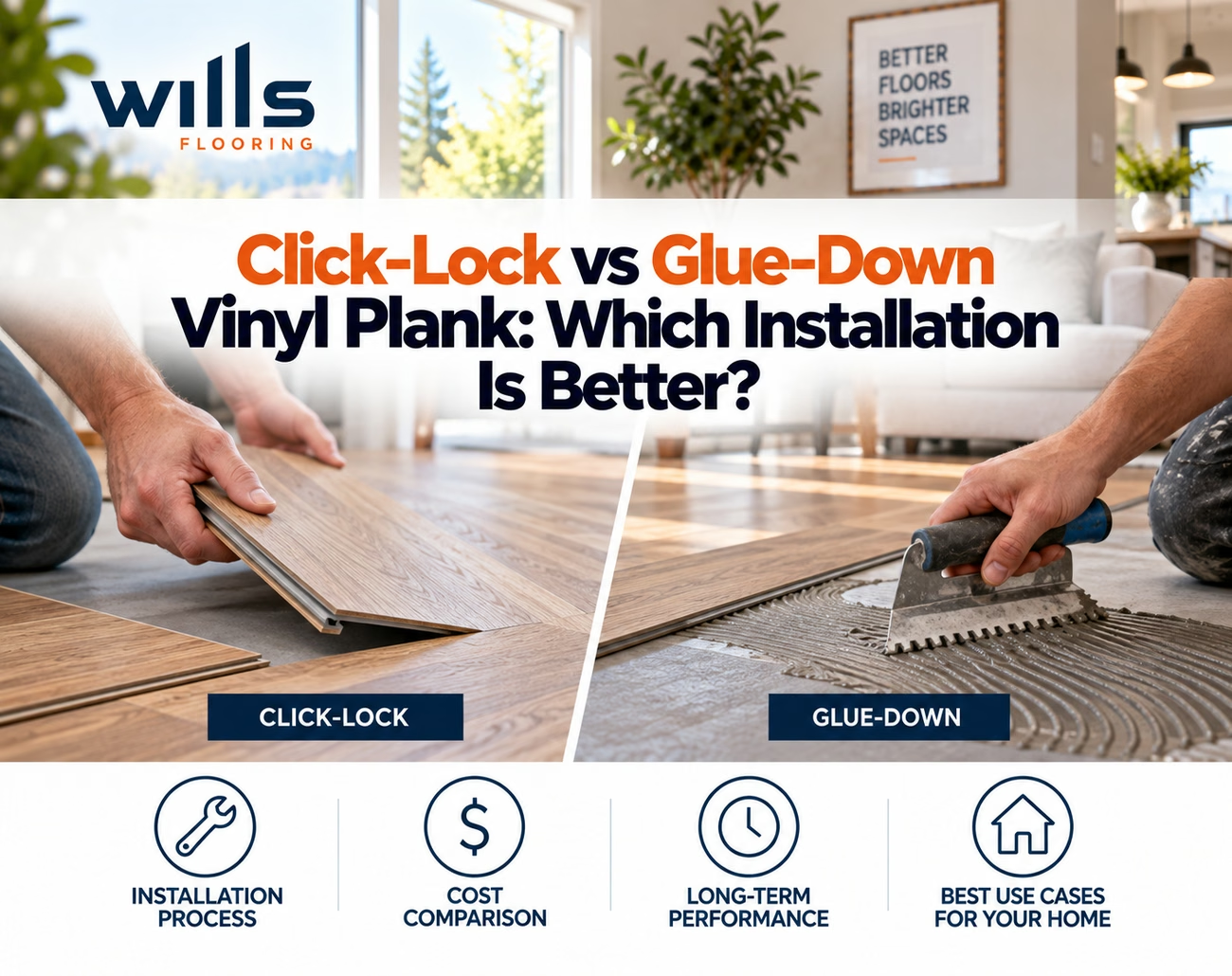
For most Seattle houses and condos, click-lock (floating) vinyl plank is the better installation: faster, kinder to imperfect subfloors, easier to repair, and it does not lock you into adhesive forever. Glue-down earns its place in large open areas, rooms with rolling loads or heavy furniture, and below-grade slabs where you want a floor that cannot shift. Wills Flooring installs both methods at $2.50 per sq ft labor with a 500 sq ft minimum. Glue-down adds adhesive and more subfloor prep, which we quote at the estimate.
A common Reddit thread asks whether glue-down is "the professional way" and click-lock is "the DIY way." That framing is wrong. Both are professional systems, and we install both across Seattle every month. What matters is your subfloor, your room sizes, and whether anyone will ever need to lift a plank again. Here is how we decide on a Ballard bungalow versus a Capitol Hill condo versus a West Seattle basement.
How each method actually works
Floating
Click-lock
Planks snap together at the edges and the whole floor floats over the subfloor as one connected sheet, held down by its own weight and the baseboards. Nothing is glued or nailed. A perimeter gap of about 1/4 inch lets the floor expand and contract.
Adhered
Glue-down
A pressure-sensitive or hard-set adhesive is troweled onto the subfloor and each plank is set into it. The floor becomes part of the subfloor. No expansion gap is needed, so long runs and open plans need no transition strips.
Feel underfoot
How they feel
Glue-down feels solid and quiet, closer to tile. Click-lock over an attached pad feels slightly softer and can sound hollow if the subfloor has dips. On a flat subfloor most people cannot tell the difference in socks.
Repairs
Fixing one plank
Click-lock: pull the baseboard, unclick back to the damaged plank, replace it, reassemble. Glue-down: heat the plank, cut it out, scrape adhesive, glue a new one. Both are doable, but click-lock is cleaner and we can often do it in an hour.
Head to head on the things that matter
| Factor | Click-lock (floating) | Glue-down |
|---|---|---|
| Subfloor flatness | Needs 3/16 in over 10 ft; forgives small dips with an attached pad | Needs the same flatness but shows every bump, since the plank follows the floor |
| Moisture from concrete | Needs a vapor barrier; the floor is not bonded, so it tolerates minor vapor | Adhesive can fail with high slab moisture; a moisture test is mandatory |
| Large open areas | Needs a T-molding roughly every 40 to 50 ft, depending on the product | No transitions needed; one continuous floor |
| Rolling chairs, heavy furniture | Fine with rigid core; joints can stress under piano-weight loads | Best choice; nothing can shift |
| Sound | Can sound hollow over dips; attached pad helps | Quiet and solid |
| Removal later | Comes up in an afternoon and can be reused | Slow, adhesive residue stays on the subfloor |
| Install time, 800 sq ft | 1 to 2 days | 2 to 3 days including adhesive open time |
Labor is $2.50 per sq ft for either method. Glue-down adds adhesive cost and usually more floor prep, which is why total quotes for glue-down run higher.
What Seattle homes push you toward
- 1920s Wallingford or Ballard bungalow. Old fir subfloors are rarely flat and often have a little bounce. Click-lock with a rigid SPC core and an attached pad bridges that better than glue, which would need a full skim coat first.
- Capitol Hill or Queen Anne condo. HOAs care about impact noise. A click-lock plank with an IIC-rated attached pad, or a separate acoustic underlayment, usually satisfies the building. Glue-down over concrete transmits more sound unless you add an acoustic layer first.
- West Seattle or Beacon Hill basement slab. Both methods work if the slab tests dry. If the moisture reading is borderline, click-lock over a 6 mil vapor barrier is the safer bet, because an adhesive failure means starting over.
- Home office with a rolling chair or a piano. Glue-down. Constant rolling loads and point weight are the one residential case where a bonded floor clearly wins.
- Open-plan main floor over 50 ft long. Glue-down avoids the T-molding a floating floor needs mid-room. If you hate transitions, this is the reason to glue.
Price your Seattle vinyl plank install right now
Vinyl Plank Installation Calculator
Installation pricing from our published rate card. Material is quoted separately based on the plank you choose.
Two Seattle examples with the math
- Greenwood split-level · 900 sq ft + 13 stairsClick-lock SPC over the old oak upstairs and a plywood subfloor below, stairs wrapped in matching plank and nosing.900 × $2.50 + 13 × $100 = $3,550 labor; plank, underlayment and nosings quoted separately
- Magnolia daylight basement · 650 sq ftGlue-down over a tested concrete slab, home office with rolling chairs and a gym corner, no transitions.650 × $2.50 = $1,625 labor plus adhesive and slab prep quoted on site
When each method is the wrong choice
Do not float when
Click-lock is wrong if
- The room takes constant rolling loads or a 600 lb safe
- You want zero transitions across a huge open plan
- The product is a thin flexible LVP with no locking system
- The subfloor has dips deeper than 3/16 in that will not be leveled
Do not glue when
Glue-down is wrong if
- The concrete slab has not passed a moisture test
- You are installing over existing vinyl, tile or old hardwood
- The subfloor is old fir with movement or gaps
- You may want the floor out again in a few years, as in a rental
One thing nobody mentions: Glue-down over existing sheet vinyl in a pre-1980 Seattle house is a bad idea twice over. The adhesive bond to old vinyl is unreliable, and disturbing old sheet vinyl or its backing can release asbestos. Float over it if it is flat and intact, or have it tested and abated before anything is glued.
What to ask before you sign either quote
- Which method are you quoting, and why for my subfloor? A good answer names the subfloor material and its flatness.
- What is the expansion gap plan, and where will transitions land? Ask to see them marked on a sketch.
- For glue-down: which adhesive, what is the slab moisture reading, and how long before furniture can go back?
- For click-lock: does the plank have an attached pad, or is a separate underlayment included in the quote?
- Is subfloor prep a line item or an allowance? At Wills it is checked at the estimate and written into the firm quote, not discovered on install day.
- Who handles the old floor? Tear-out and haul-away are quoted separately at our free estimate, and the answer changes if we can float over what is there.
Click-lock vs glue-down questions from Seattle homeowners
From estimates in Ballard, Capitol Hill, West Seattle and Beacon Hill.
Is glue-down vinyl plank more durable than click-lock?
Does Wills Flooring charge more for glue-down installation?
Can click-lock vinyl plank go over my old Seattle hardwood?
Which is better for a Seattle condo with sound rules?
How soon can I walk on a glue-down floor?
Is loose-lay vinyl a third option?
Let us look at your subfloor before you pick a method
We bring plank samples to your Seattle home, check flatness and moisture, and quote the right installation in writing on the spot. Free, no obligation.
Wills Flooring serves Seattle, Everett, Sammamish, Lynnwood, Edmonds, Kirkland, Snohomish and the rest of Snohomish and King County from our Lynnwood showroom. See our vinyl plank flooring service, published price list, is vinyl plank really waterproof, how flat a subfloor needs to be and SPC vs WPC vinyl plank.