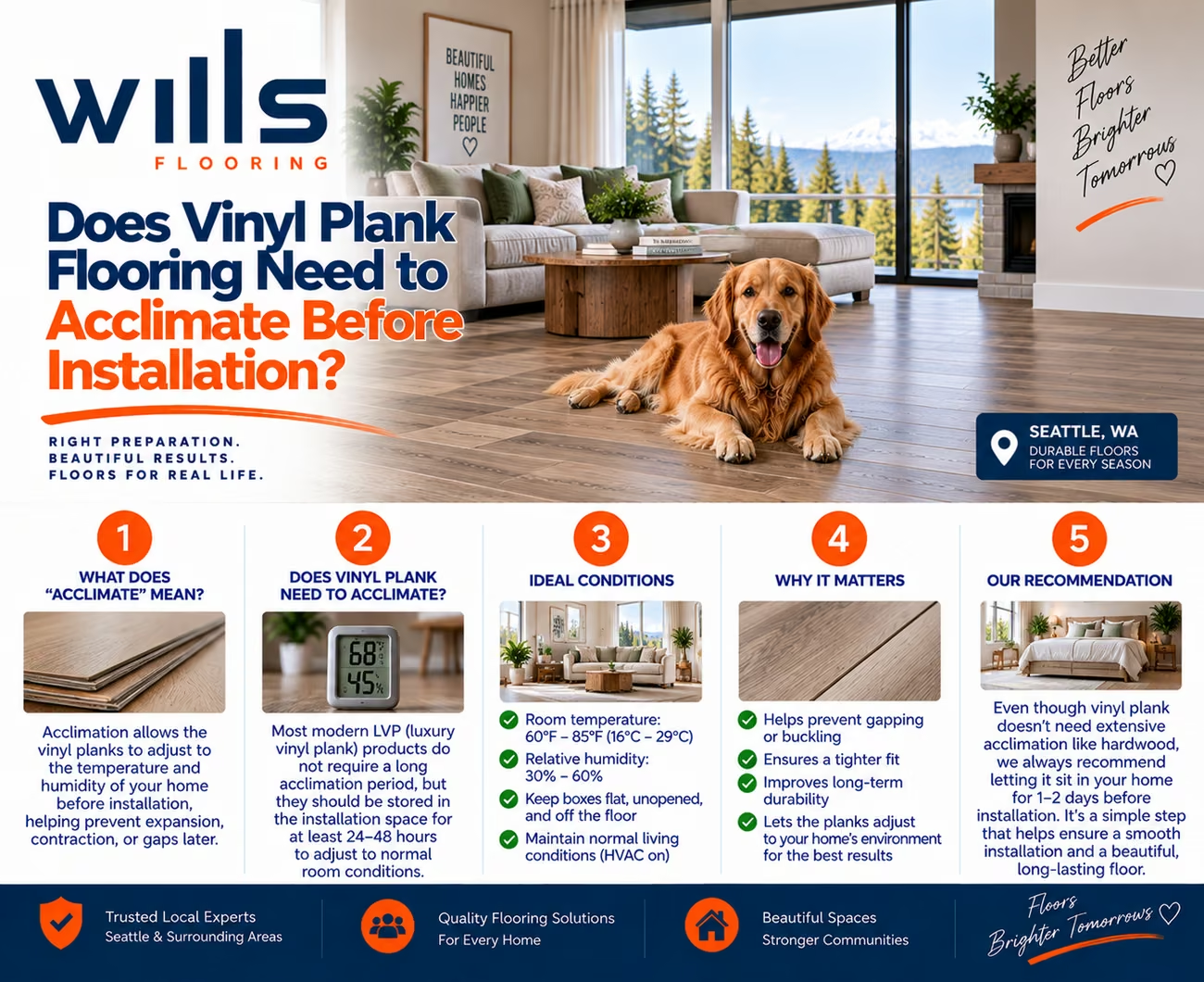
Yes. Nearly every vinyl plank manufacturer requires the boxes to sit in the room where they will be installed for 48 hours at 65 to 85 degrees, and skipping it is the most common reason a warranty claim gets denied. Vinyl does not absorb moisture the way wood does, so this is about temperature, not humidity. A plank that goes down cold expands when the house warms up and peaks at the joints; a plank that goes down hot shrinks and gaps in winter.
A common Reddit thread asks whether acclimation is a real requirement or a way for installers to pad the schedule. It is real, and Edmonds is a good place to see why. Boxes get delivered to a Seaview rambler on a 40-degree November afternoon and stacked in the garage. Two days later a crew carries them into a 70-degree living room and starts clicking planks together that are still cold in the middle. By February the joints have lifted into little ridges along the hallway. Here is what the instructions actually say, why it matters more for some products than others, and how to do it right in a house that is being lived in.
Why vinyl moves, and why it is not about moisture
Thermal expansion
Vinyl and its plasticizers expand when warm and shrink when cool, more than wood does across a plank's length. A 20 ft run of flexible LVP can change by more than 1/4 in between a cold delivery and a heated room. That is the gap or the peak you see later.
Humidity barely matters to the plank
Unlike hardwood, vinyl does not take on water from the air. Edmonds waterfront humidity and the Bowl's marine air will not swell a plank. Moisture matters only for what is under the floor: a damp slab or crawlspace subfloor needs a moisture test before any plank goes down.
SPC is stiffer, not immune
Rigid stone-plastic core planks move about half as much as flexible vinyl and are marketed as needing little or no acclimation. Read the fine print: most still require the boxes to be at room temperature before installation, and all of them require the room itself to be within range.
Heat swings after install matter too
A south-facing Edmonds sunroom or a slider with afternoon sun can heat a plank floor well past 85 degrees. Acclimation cannot fix that; product choice and expansion gaps at the walls do. We flag those rooms at the estimate.
What the instructions usually say, by product type
| Product | Acclimation time | Temperature | Notes |
|---|---|---|---|
| Flexible glue-down LVP | 48 to 72 hours | 65 to 85 degrees | Most sensitive to temperature; adhesive also has its own temperature range |
| WPC click (wood-plastic composite core) | 48 hours | 65 to 85 degrees | Softer core, expands more than SPC; keep boxes flat and out of sun |
| SPC click (stone-plastic composite core) | 24 to 48 hours | 60 to 85 degrees | Stiffest option; still must be room temperature at install |
| Loose lay vinyl plank | 48 hours | 65 to 85 degrees | Friction backing needs a warm, clean subfloor |
| Laminate (for comparison) | 48 to 72 hours | 65 to 85 degrees, 35 to 65% humidity | Laminate has a wood-fiber core, so humidity does matter here |
Times and ranges are typical manufacturer requirements. The exact numbers are printed in the box and on the warranty; we follow the ones for the plank you choose.
How to acclimate correctly in a house you are living in
- Three days beforeBoxes are delivered and carried into the rooms where they will be installed, not the garage or a covered porch. Confirm delivery timing and the selected product's acclimation requirements before installation.A garage in November is 45 degrees. Acclimating there does nothing.
- StackingCartons lie flat, stacked no more than three or four high, with space between stacks so air reaches every box. Do not stand them on end; planks bow.
- 48 hours beforeThe house is at its normal living temperature, 65 to 75 degrees, and stays there. If the heat has been off in an empty house, it goes on now, not the morning of the install.
- Install daySubfloor is checked for flatness and, over concrete, for moisture. Planks are pulled from several boxes at once to mix shade variation. Expansion gaps at the walls are set per the product.
- 48 hours afterThe room stays within the same range while the floor settles and, for glue-down, while the adhesive cures. Then live on it normally.
Price your Edmonds vinyl plank installation right now
Vinyl Plank Installation Calculator
Installation pricing from our published rate card. Material is quoted separately based on the plank you choose.
What happens when acclimation is skipped
Acclimated
What you get when it is done right
- Joints stay tight through summer and winter
- Expansion gaps at the walls stay hidden under the baseboard
- Click joints lock fully because planks are at the same temperature
- Warranty stays valid if a plank ever fails
Skipped
What we get called to fix
- Peaked ridges at the joints in the first warm month, from cold planks expanding
- Gaps between planks in January, from warm planks shrinking
- Click joints that would not fully seat and lifted later
- A manufacturer inspector asks for the acclimation record and denies the claim
Edmonds condos and vacant homes: Two situations trip people up. Condos in the Bowl often store deliveries in an unheated garage or storage cage, and estates being prepared for sale often have the heat off. In both cases, the boxes need to move into a heated room two full days before we arrive. We check at the estimate and tell you the delivery date that makes it work.
Questions to ask your installer about acclimation
- Which specific acclimation requirement applies to this plank? The answer should be a number of hours and a temperature range from the manufacturer, not "vinyl does not need it."
- When does the material arrive, and where does it sit? In the install rooms, two to three days ahead. If the installer wants to bring it from a cold truck the morning of the job, that is a red flag.
- What temperature does the house need to be, and for how long? Before, during and after. Ask what to do if you are between tenants or the home is empty.
- Is a subfloor moisture test included over concrete? Acclimation handles the plank; a moisture test handles the slab. Edmonds daylight basements and slab-on-grade additions need it. See why vinyl plank needs a moisture test over concrete.
- Who keeps the acclimation record? Delivery date, install date and room temperature. If a plank ever fails, that record is what the manufacturer asks for first. Wills Flooring keeps it with the job file, alongside our 1-year workmanship warranty.
Acclimation questions from Edmonds homeowners
Asked most often in the cold months, when it matters most.
How long does vinyl plank flooring need to acclimate?
Does SPC vinyl plank need to acclimate?
Can I acclimate vinyl plank in the garage?
Does humidity matter for vinyl plank acclimation?
What happens if vinyl plank is installed without acclimating?
Does Wills Flooring handle acclimation on Edmonds installs?
Get a schedule that includes the 48 hours
We bring plank samples to your Edmonds home, check the subfloor, set the delivery date for proper acclimation, and leave a firm written quote. Free, no obligation.
Wills Flooring serves Edmonds, Everett, Seattle, Sammamish, Lynnwood, Kirkland, Snohomish and the rest of Snohomish and King County from our Everett office. See our vinyl plank flooring service, published price list, why vinyl plank buckles or gaps, installing vinyl plank in winter and hardwood acclimation, for comparison.