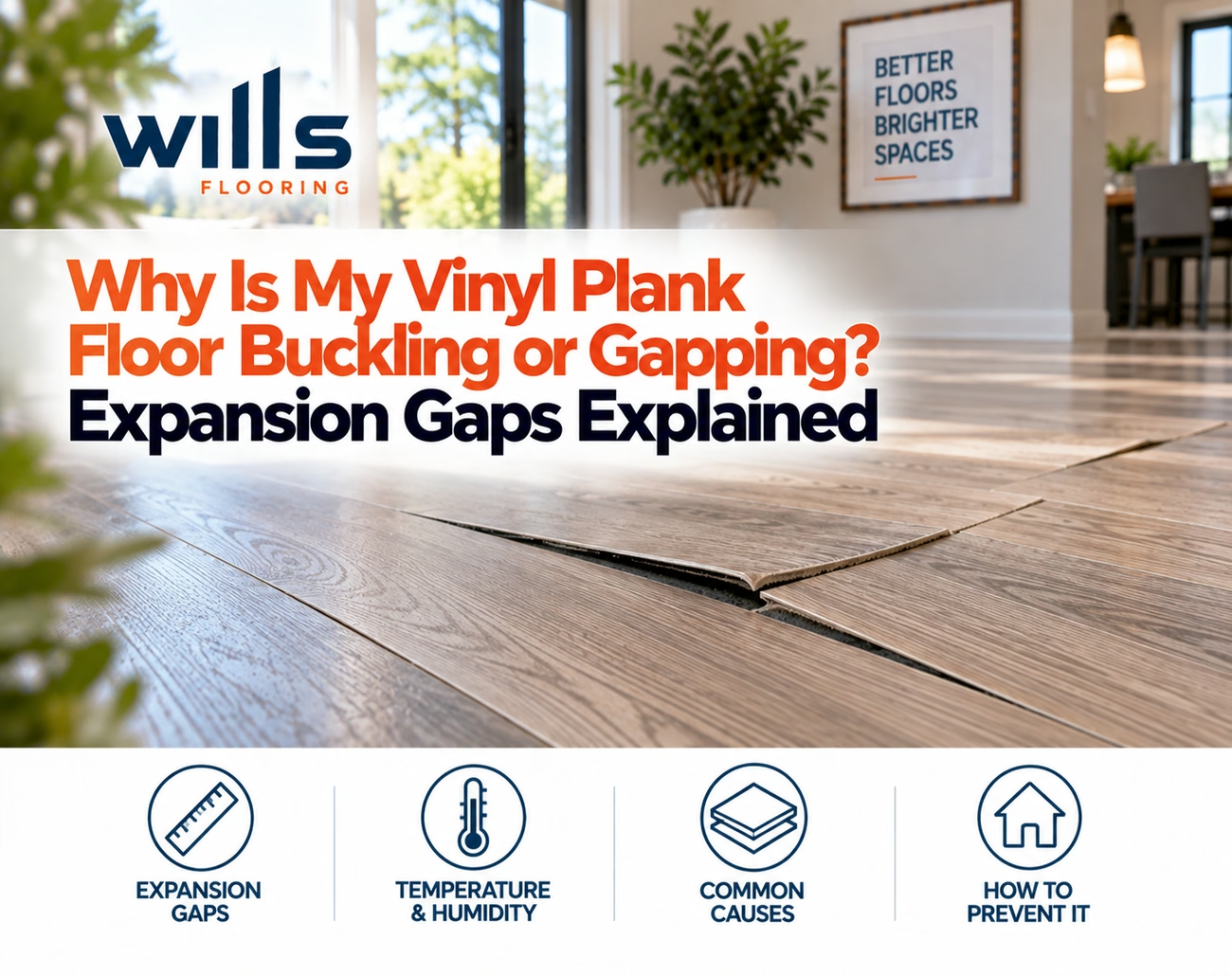
Vinyl plank buckles because it expanded and had nowhere to go, and it gaps because it shrank or was never fully locked. Both usually trace back to the expansion gap at the walls. Floating vinyl plank moves with temperature. Pin it against a wall, a cabinet or a door jamb and the pressure lifts a ridge. Install it cold and tight, then heat the house, and the joints pull apart.
A common Reddit thread goes: "Our vinyl plank was installed last spring and now there is a hump in front of the slider." In Sammamish that slider usually faces south or west over a plateau backyard, the room is a big open-plan main floor in Klahanie or Trossachs, and the plank was sold as waterproof, so the owner assumes it should be indestructible. Water is not the problem. Heat, cold and a floor that cannot move are.
Why a floating floor needs room to move
Click-lock vinyl plank is not attached to the subfloor. Every plank is locked to its neighbors and the whole floor sits as one sheet that grows when it warms and shrinks when it cools. On a 30 ft open-plan room that movement can approach 1/4 in between a January morning and an August afternoon. Manufacturers require a gap at every wall, cabinet, post and door jamb, hidden under the baseboard, so the sheet has somewhere to go. Take that gap away and the energy releases upward.
Four reasons vinyl plank buckles
Direct sun through big glass
A south-facing slider in Pine Lake or Beaver Lake can push plank surface temperature past 100 degrees on a July afternoon while the rest of the floor stays at 70. That strip expands faster than everything around it and lifts. Dark planks are worst. Blinds during peak sun help more than anyone wants to hear.
No gap, or a gap that got filled
The most common find when we pull a baseboard: planks cut tight to the drywall, or a gap that was later packed with caulk or a bead of construction adhesive under the shoe molding. Either one turns a floating floor into a pinned floor.
Pinned under a kitchen island or vanity
Builders in the 1990s and 2000s Sammamish subdivisions often set the island on top of the flooring. A floating floor under 400 lb of cabinet and stone cannot move, so it buckles on the side that gets sun or traffic. Islands and vanities should sit on the subfloor with plank cut around them.
Subfloor that is not flat
A hump in the subfloor looks exactly like a buckle. Plank bridging a 1/4 in high spot rocks, the joints open and close, and eventually one pops up. On a crawlspace home this is often a joist crown, not the flooring. See how flat a subfloor needs to be.
Why vinyl plank gaps
| What you see | Likely cause | Fix |
|---|---|---|
| Even gaps at many end joints in winter | Floor shrank as the house dried and cooled; planks were installed tight in warm weather | Often closes in summer. If not, a row is re-locked from the nearest wall. |
| One gap at a long-side joint | Plank was never fully engaged in the locking profile, then foot traffic walked it open | Pull back to that row from the wall, re-lock, replace any plank with a damaged tongue. |
| Gaps next to a hump | Buckle in one area pulled planks apart in another | Fix the buckle first; the gaps usually close on their own. |
| Gap at a doorway or transition | Two rooms moving differently with no T-molding | Add a transition strip that lets each room float on its own. |
| Gaps where a heavy piece sits | A piano or a loaded bookcase is pinning the floor on one side | Move or pad the load, then re-lock the open joints. |
Vinyl plank does not gap from water in any normal amount. If the gaps come with soft or spongy spots, the subfloor is the problem and it needs to be looked at.
Price a Sammamish vinyl plank fix or reinstall
Vinyl Plank Installation Calculator
Installation pricing from our published rate card. Material is quoted separately based on the plank you choose.
How we fix a buckled floor in Sammamish
- Step 1 · Find the pinchWe pull the baseboard on the two walls closest to the hump and look for tight planks, caulk, adhesive, a nailed transition or a cabinet sitting on the floor.
- Step 2 · Cut the gap backAn oscillating saw trims the plank edge to a 3/8 in gap at the wall. Usually the ridge drops the moment the pressure has somewhere to go.
- Step 3 · Re-lock the damaged rowsPlanks that lifted often have a crushed locking edge. We disassemble to that row from the wall, swap the damaged planks and re-lock.Keep a box of leftovers. Matching a discontinued plank three years later is the hard part.
- Step 4 · Add a transition if the run is too longIf the room exceeds the manufacturer's maximum, a T-molding at a doorway splits it into two floors that move independently.
- Step 5 · Reinstall trim and check the gap everywhere elseIf one wall was tight, the others probably are too. We check all of them so the buckle does not move to a new spot next summer.
Mistakes that make it worse
- Screwing or nailing the hump down. The pressure does not disappear; it moves to the next joint and the screw head shows forever.
- Caulking the gap at the wall for a cleaner look. Paintable caulk hardens and pins the floor. Shoe molding hides the gap without touching the plank.
- Spot gluing a floating plank. A few glued planks create fixed points in a floor designed to move as one sheet. Either fully glue a glue-down product or fully float a click product.
- Ignoring it because it is small. A 1/8 in ridge in June is a cracked locking edge by September. Early fixes are cheap.
If your floor was installed in winter: A floor laid tight in a 60 degree house in January has all of its expansion still ahead of it. The same goes for a Trossachs house left at 50 degrees over the holidays and then heated to 72 in a day. If the first summer brings a hump near the windows, the installer left too little gap. Get it looked at before the second summer does more damage.
What to ask before the next vinyl plank goes in
- What expansion gap will you leave, and how will you handle the island, the fireplace hearth and the door jambs?
- Will the kitchen island and bathroom vanities sit on the subfloor or on the plank?
- Where will the transitions go in an open plan, and what is this product's maximum run?
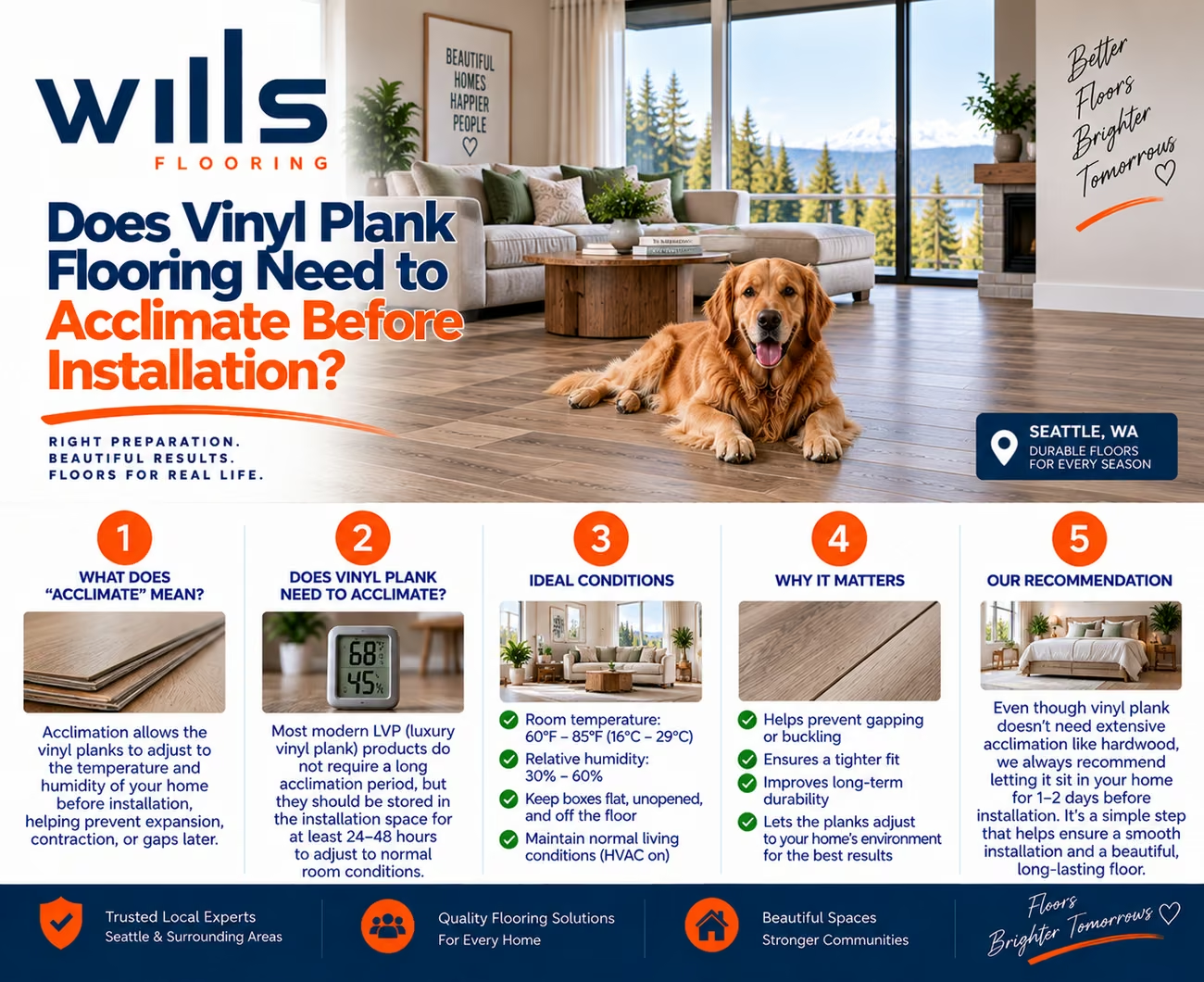
- Was the plank acclimated in the room at normal living temperature for 48 hours?
- Do I get the leftover boxes? Keep them; a discontinued plank is hard to match later.
Buckling and gapping questions from Sammamish homeowners
Asked on Reddit, on Google and during phone consultations.
Can a buckled vinyl plank floor be fixed without replacing it?
How big should the expansion gap be for vinyl plank?
Will the gaps in my vinyl plank close on their own?
Is buckling covered by the flooring warranty?
Does direct sunlight really buckle vinyl plank?
How much does it cost to re-lay a vinyl plank floor?
Get your Sammamish vinyl plank floor looked at
We find the pinch point, tell you whether it is a two-hour fix or a re-lay, and write the price on the spot. Free estimate anywhere on the plateau.
Wills Flooring serves Sammamish, Everett, Seattle, Lynnwood, Edmonds, Kirkland, Snohomish and the rest of Snohomish and King County from our Everett office. See our vinyl plank flooring service, published price list, why vinyl plank lifts and peaks, vinyl plank in the Sammamish climate and acclimating vinyl plank before installation.