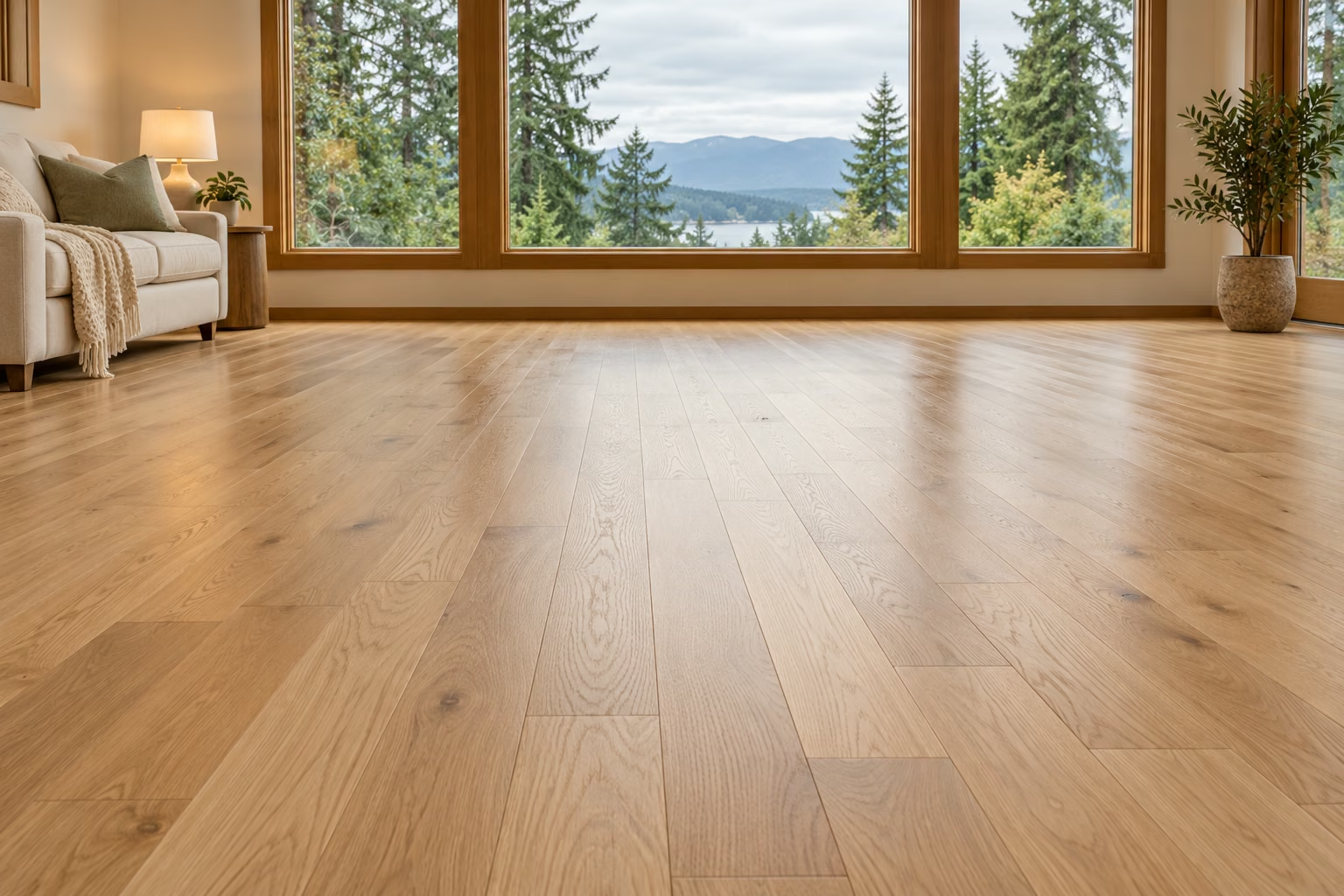
A standard 3/4 in solid hardwood floor can be fully sanded and refinished about 4 to 6 times over its life. Each sanding removes roughly 1/32 in of wood, and the floor is done when less than about 3/32 in remains above the tongue. Screen-and-recoats do not count against that number because they remove only finish, not wood. A 1920s Seattle floor sanded two or three times usually has two more in it, if past crews were careful.
This is the question behind a lot of nervous Seattle estimates. An owner in Wallingford or Queen Anne has a 1925 oak floor that was refinished when they bought the house, once more after a kitchen remodel, and now carries a dog's worth of scratches. Is one more sanding fine, or are they about to hit nails? The answer is not a fixed number; it is a measurement, and you can take it yourself with a ruler at a floor register before you call anyone.
Where the 4 to 6 number comes from
The math of a 3/4 in board
A standard solid strip is 3/4 in thick, but the sandable part is only the wood above the tongue and groove, roughly 1/4 in, or 8/32 in. A careful professional sanding removes about 1/32 in. Stop at 3/32 in above the tongue so boards do not split or show fastener heads, and you have about five sandings across the floor's life.
Careless sandings cost two
An aggressive drum sander held still for a second digs a trough, and the crew has to take the whole floor down to that level. Rented DIY machines and the belt sanders used through the 1970s routinely removed 1/16 in or more. That is why two 1920s floors with the same history can have very different wood left.
Engineered floors follow different rules
An engineered plank has a veneer of 0.6 to 6 mm over plywood. A 2 mm veneer takes one sanding, 3 mm one or two, 4 mm and up two or three. Under 2 mm it can only be recoated. Most Capitol Hill and downtown condo floors are engineered, so the 4 to 6 rule does not apply to them.
Fir and softwoods run thinner
Old-growth Douglas fir floors in Ballard, Beacon Hill and West Seattle bedrooms are often 3/4 in but softer, so each sanding takes a little more wood and the boards were frequently laid thinner than oak. Budget for one fewer sanding than the oak math suggests, and always use the finest grit sequence that will do the job.
Sandings by floor type
| Floor | Sandable wood | Lifetime full sandings | Notes |
|---|---|---|---|
| 3/4 in solid oak strip | About 1/4 in above the tongue | 4–6 | The classic Seattle floor, 1900s through 1970s |
| 3/4 in solid Douglas fir | About 1/4 in, softer | 3–5 | Softer wood, more removal per pass |
| Engineered, 4–6 mm veneer | 4–6 mm | 2–3 | Behaves like solid for refinishing |
| Engineered, 2–3 mm veneer | 2–3 mm | 1–2 | Fine grits only; no drum sanders |
| Engineered, under 2 mm | Too thin | 0 | Screen and recoat at $1.99 per sq ft is the only option |
These assume professional sanding at about 1/32 in per pass. Deep gouges, cupping or pet stains that must be sanded out remove more.
Price your Seattle refinish right now
Refinishing Calculator
Real Wills Flooring pricing. Pick the service, enter your area, and see the number before anyone visits.
How to check how many sandings your floor has left
- Step 1 · Lift a floor registerThe cut edge of the boards is visible around the duct. Measure from the top of the board to the top of the tongue. At 1/4 in you have a nearly new floor; at 1/8 in you have one, maybe two, sandings left; at 3/32 in or less, stop.
- Step 2 · Look for exposed nail heads or fillerShiny spots along the board edges are the tops of cleats coming into view, and rows of wood filler dots usually mean a previous crew already hit them. Either one says the floor is close to done.
- Step 3 · Check the edges and the bevelsA floor that has been sanded several times is often noticeably lower in the room than under the baseboard or at a closet edge. A step of 1/16 in or more at a threshold is a sign of several past sandings.
- Step 4 · Let us measureAt the free estimate we check thickness at two or three points, note previous sandings and tell you plainly whether this is a sanding, a recoat or a replacement.
Sand again, recoat, or start over?
Sand once more
Sand when
- At least 1/8 in of wood remains above the tongue
- Damage goes through the finish into the wood: gray boards, deep scratches, pet stains
- You want to change the color
- A recoat was already tried and the finish did not bond
Recoat or replace
Do not sand when
- Less than 3/32 in remains, or nail heads are showing
- The finish is dull but intact: a $1.99 screen and recoat fixes it and costs no wood
- Boards are cracked, loose or already patched heavily
- You would rather put the money toward a new floor with a full lifetime ahead of it
How to make your remaining sandings last decades: Recoat every 7 to 10 years, before the finish wears through to bare wood. A $1.99 per sq ft screen and recoat removes nothing but the top layer of finish, and homeowners who do this keep the same floor for a century. Wait until the wood turns gray and you spend a full sanding every 12 to 15 years and run out of floor.
Ways to stretch a floor's remaining life
- Recoat before you need to sand. If water still beads on the floor and there is no bare wood, you are a recoat customer, not a sanding customer.
- Ask for a light sanding sequence. A flat, lightly scratched floor does not need to start at 36 grit. Starting at 50 or 60 grit on a multi-head machine removes less wood.
- Skip stain on a thin floor. Stain shows every sanding mark, so crews sand deeper to prepare for it. Natural finish at $3.99 per sq ft is gentler on the wood than stain at $6.50.
- Choose a durable finish. Three coats of a commercial-grade water-based finish outlast two coats of a cheaper product by years. As Bona Certified Craftsmen we apply the finish system we would put in our own homes.
- Fix the cause, not just the floor. Grit from a Green Lake entry, a leaking dishwasher or an untrimmed dog wears through any finish. Mats, felt pads and nail trims are cheaper than 1/32 in of oak. See our refinishing service page for how we handle older floors.
Refinishing lifespan questions from Seattle homeowners
From century-old Craftsman floors to Capitol Hill condos.
How much wood does refinishing remove?
Can a 100-year-old hardwood floor be refinished?
How do I know if my hardwood floor is too thin to refinish?
Does a screen and recoat count as a refinish?
How often should hardwood floors be refinished?
What happens if you sand through to the tongue?
Find out how many sandings your floor has left
We measure the wood at the estimate and tell you honestly whether to sand, recoat or replace. Free in-home visit anywhere in Seattle, firm price in writing.
Wills Flooring serves Seattle, Everett, Sammamish, Lynnwood, Edmonds, Kirkland, Snohomish and the rest of Snohomish and King County from our Lynnwood showroom. See our hardwood refinishing in Seattle, WA, hardwood refinishing service, published price list, how thick hardwood needs to be to refinish, refinishing engineered floors and refinish or replace checklist.