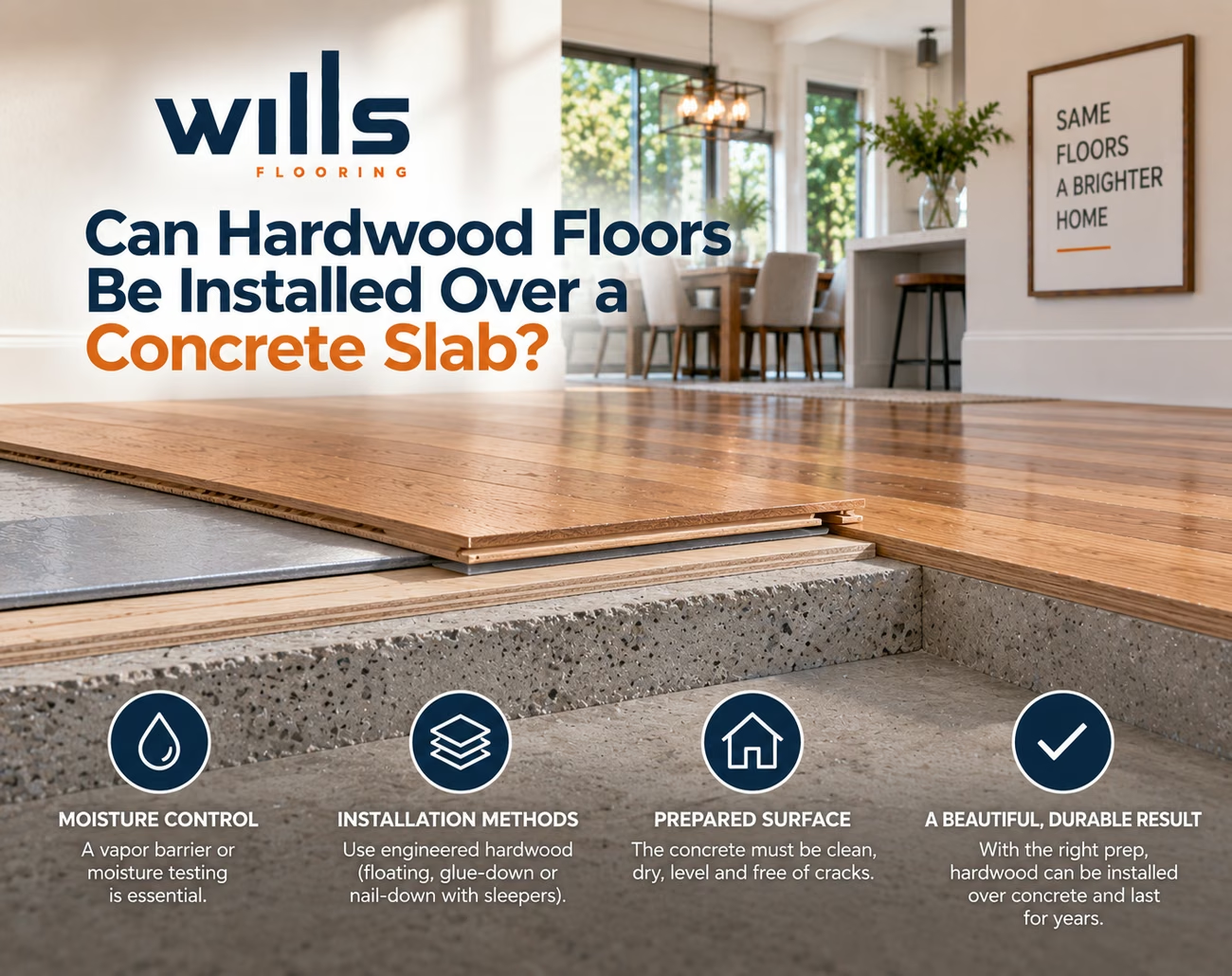
Yes. Hardwood can be installed over a concrete slab, but only as engineered hardwood glued or floated directly on the concrete, or as solid hardwood over a plywood subfloor built on top of the slab, and only after the slab passes a moisture test. Wills Flooring installs all three methods at $3.25 per sq ft for labor. The slab itself adds cost that a wood-subfloor house does not have: moisture testing, a vapor barrier or moisture-mitigation coating, sometimes leveling, and for solid wood a full plywood layer. Here is how to choose.
In Edmonds this question comes from two kinds of houses. Hillside homes in Seaview, Westgate and up toward Perrinville have daylight basements poured into the slope, and owners want the family room down there to match the oak upstairs. And a good number of 1950s to 70s ramblers in Esperance and near the Bowl were built slab-on-grade, so the whole main floor is concrete under the carpet. Both can have hardwood. Neither can have it the way you would install it over plywood.
Three ways to put hardwood on concrete
Most common
Glue-down engineered
Planks are set in a moisture-cure urethane adhesive troweled onto the slab. Many adhesives double as a vapor barrier. Solid feel, no hollow sound, works with radiant heat, and it is the standard for daylight basements. Slab must be flat and tested first.
Fastest
Floating engineered
Click-lock or glued-edge planks float over a pad and a 6 mil poly vapor barrier. Quick, forgiving of minor slab imperfections, easy to repair. Can sound hollow, and wide planks may flex. Good for bedrooms and bonus rooms, less ideal for a large open basement.
For solid wood
Plywood subfloor, then nail-down
A vapor barrier goes down, then 3/4 in plywood is fastened to the slab or laid as a floating double layer, then solid hardwood is nailed to it. Adds about 1 1/2 in of height, real cost, and still leaves solid wood exposed to slab moisture. We recommend it only when matching existing solid floors is the goal.
Moisture test first, every time
- Step 1 · LookEfflorescence (white mineral dust), dark patches, peeling paint on the slab or a musty smell are all signs of a slab that is passing water. In Edmonds basements dug into wet hillsides, we see it often.
- Step 2 · Plastic sheet testAn 18 in square of plastic taped to the slab for 24 to 72 hours. Condensation or a dark spot underneath means moisture is moving. A cheap, useful first screen, not a pass.
- Step 3 · Calcium chloride or in-situ RH probesThe tests manufacturers actually require. Calcium chloride measures vapor emission in pounds per 1,000 sq ft per 24 hours; most floors allow 3 lb. RH probes drilled into the slab typically need to read 75 percent or lower.Fail either, and the floor warranty is void without mitigation
- Step 4 · DecidePass: proceed with the method you chose. Marginal: add a moisture-mitigation epoxy or a vapor-barrier adhesive. Fail badly: fix the drainage problem first, or choose a floor that does not care about water.
Which method for which slab
| Your situation | Best method | Notes |
|---|---|---|
| Dry, flat daylight basement, family room | Glue-down engineered | Most solid feel; radiant compatible; no added height. |
| Slab a bit uneven, bedroom or bonus room | Floating engineered | Pad hides minor dips; leveling still needed over 3/16 in in 10 ft. |
| Slab-on-grade rambler, whole main floor | Glue-down engineered | Continuous floor, no transitions; mitigation coating if readings are marginal. |
| Matching original solid oak upstairs | Plywood subfloor + nail-down solid | Height change at stairs and doors must be planned; most expensive route. |
| Radiant heat in the slab | Glue-down engineered, radiant-rated | Solid wood is generally not recommended over radiant. |
| Slab fails moisture test | Fix water first, or LVP | No hardwood method is warrantied over an actively wet slab. |
Price the installation
Hardwood Installation Calculator
Installation pricing from our published rate card. Material is quoted separately based on the floor you choose.
What the slab adds to the bill
- Moisture testing. We do the plastic-sheet screen at the estimate. Calcium chloride or RH probe kits are a modest cost and take one to three days before install.
- Adhesive or vapor barrier. Urethane adhesive with an integrated moisture barrier costs more per gallon than plain adhesive but replaces a separate mitigation step on most slabs.
- Moisture-mitigation epoxy. For slabs that read high, a rolled epoxy coating brings them into spec. This is the biggest single extra on a wet Edmonds hillside basement.
- Leveling. Glue-down floors need the slab flat to about 3/16 in over 10 ft. Self-leveling compound is priced by the bag and the area.
- Plywood subfloor for solid wood. Material plus fastening labor plus the height adjustments at doors, stairs and toilets. This is why we steer most slab jobs to engineered.
- The flooring itself. Quoted separately once you pick a sample. We are a Metropolitan Hardwood distributor and bring the boards to your house.
When to say no to hardwood on the slab
Go ahead
Hardwood on concrete makes sense when
- The slab passes a real moisture test or can be mitigated
- The space is finished living area, not a utility basement
- You want the room to match hardwood elsewhere in the house
- Drainage around the foundation is in good shape
Choose something else
Pick vinyl plank or tile when
- The basement has ever had standing water or seeps in heavy rain
- Efflorescence or peeling paint shows the slab is wet year-round
- A sump pump, water heater or washer sits in the same open space
- You would need to skip the moisture test to make the budget work
Edmonds basements deserve a warning: Hillside lots between the Bowl and Perrinville sit on wet, clay-heavy ground, and a slab that is bone dry in August can read wet in February. We test in the season you are installing, we tell you the number, and if it fails we will say so rather than glue down a floor that will cup by spring. Read our engineered versus solid hardwood guide to compare material choices if your house has a wood subfloor instead.
Questions to ask any installer
- Which moisture test will you run, and what reading does the flooring manufacturer require?
- Is the adhesive or underlayment you are quoting rated as a vapor barrier?
- How flat is the slab now, and is leveling in the quote?
- If we go with solid over plywood, what happens to the height at the stairs, exterior doors and bathroom?
- Who owns the warranty if the floor cups: you, the adhesive maker or the flooring maker?
- Is the installation labor separate from material? Wills publishes it at $3.25 per sq ft on the price list.
Hardwood-over-concrete questions we answer in Edmonds
From daylight basements on the hillside to slab ramblers in Esperance.
Can solid hardwood be installed directly on concrete?
Do you need a vapor barrier under hardwood on concrete?
How do you test a concrete slab for moisture before hardwood?
Is glue-down or floating engineered hardwood better over concrete?
Can hardwood go in a basement that has flooded before?
What does it cost to install hardwood over a concrete slab?
Have us test your slab before you buy a floor
We check the concrete for moisture and flatness, bring engineered samples to your Edmonds home and give you a firm price for the right method. Free, no obligation.
Wills Flooring serves Edmonds, Everett, Seattle, Sammamish, Lynnwood, Kirkland, Snohomish and the rest of Snohomish and King County from our Lynnwood showroom. See our hardwood installation service, published price list, engineered vs solid hardwood and hardwood installation methods.