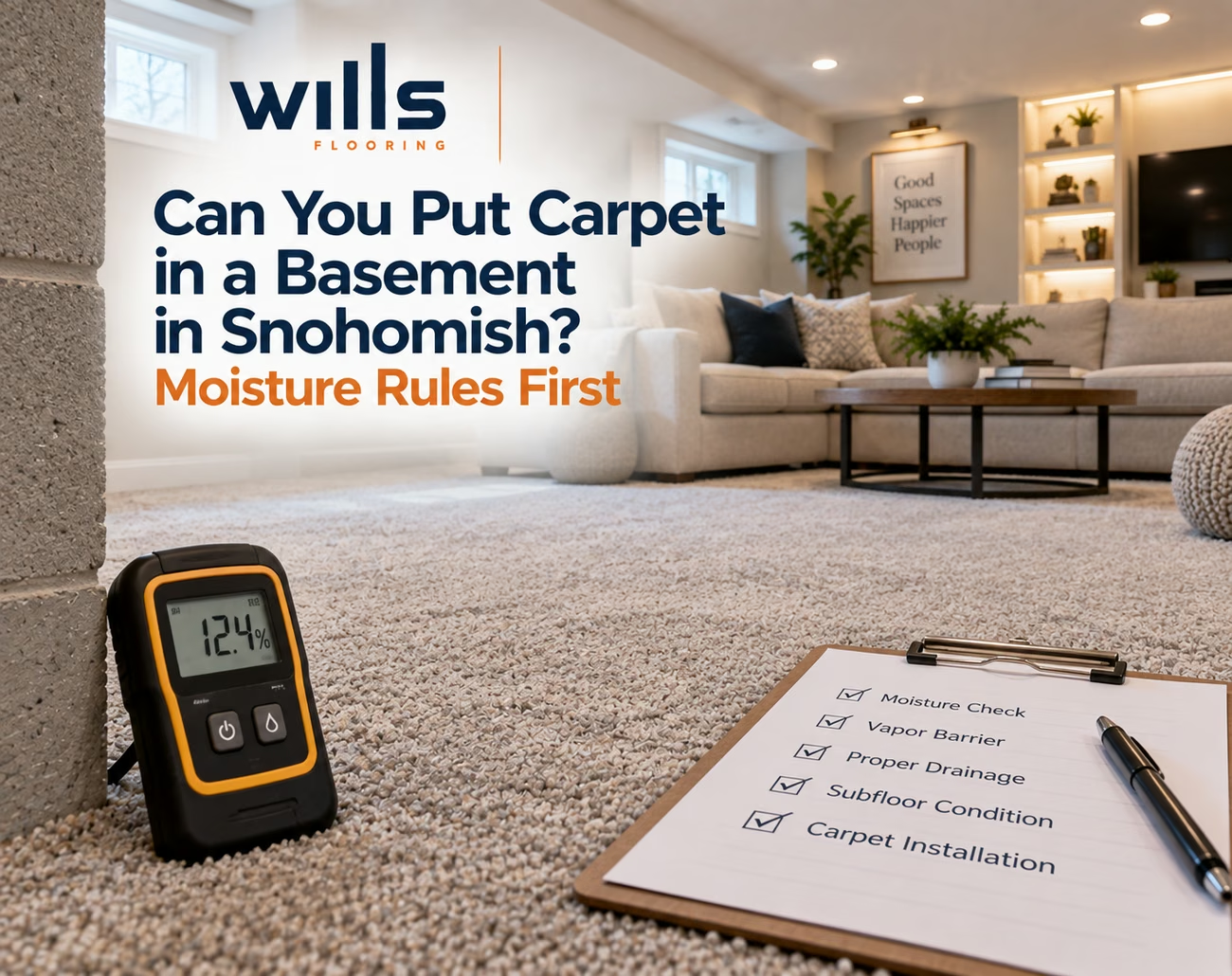
Yes, you can carpet a Snohomish basement, but only after the slab passes a moisture test, and only with synthetic fiber and a moisture-resistant pad. Most basement carpet failures are not carpet problems, they are water problems nobody measured. Test first, then choose the carpet around what the test says. Labor is $0.99 per sq ft stretched in over pad or $1.29 glued straight to the slab, with carpet and pad quoted at the estimate.
Snohomish is a crawlspace town more than a basement town, but the daylight basements on Fobes Hill, the sloped lots around Blackmans Lake and the partial cellars downtown bring this question up every fall. Someone wants a warm media room below grade and wonders whether carpet is asking for trouble. Here is how we decide, in order.
Rule one: measure the moisture before you shop for carpet
- Look for the obviousEfflorescence on the walls, a tide line, rust at the base of the water heater, a musty smell after a week of rain. Any of these means a drainage fix comes before flooring.Free at the estimate; we walk the whole basement.
- Tape test, 72 hoursA 2 ft square of plastic taped tight to the slab. If it fogs or the concrete darkens underneath, the slab is passing vapor and you need a barrier pad at minimum.Cheap, and you can do it yourself before we visit.
- In-slab RH probeFor finished basements we prefer a relative humidity probe drilled into the slab. Pad and carpet makers generally want the slab under about 75 to 80 percent RH, and the room air under 60 percent.This is the number that decides which pad you can use.
- Check the walls and window wellsSnohomish acreage lots with clay soil hold water against foundations. Window wells without drains, and downspouts dumping at the foundation, are the two things we flag most.
Which carpet survives below grade
Best fit
Olefin (polypropylene)
Olefin does not absorb water, will not mildew from a damp slab, and is the fiber in most purpose-built basement carpets. It crushes faster than nylon in a hallway, but a basement family room is not a hallway. Loop and Berber styles hide the crushing.
Solution-dyed polyester or triexta
Both resist moisture and stains and feel softer underfoot than olefin. Triexta handles the wet-boots traffic Snohomish basements get from the back door. Choose solution-dyed so a cleaning mishap does not leave a bleach line.
Carpet tiles
Modular tiles with a hard vinyl or fiberglass back are the safest option when the slab tests borderline. If a corner gets wet you lift a dozen tiles, dry the slab and put them back. The look is more office than living room.
Skip these
Wool, jute-backed carpet, anything with a natural fiber backing, and thick high-pile cut piles. Wool holds water and feeds mildew, jute rots, and dense pile dries slowly. All are wonderful upstairs and wrong down here.
The pad matters more than the carpet
| Pad type | Below-grade verdict | Why |
|---|---|---|
| Rebond (bonded urethane foam) | Only with a film face | Standard rebond is a sponge. A vapor-barrier film on top keeps slab moisture out of the backing, but the pad still holds water if the slab weeps. |
| Synthetic fiber pad | Good | Dense, flat, absorbs little water and dries fast. Firmer feel, which most people accept in a basement. |
| Flat rubber | Best for damp slabs | Closed-cell rubber barely absorbs water and feels solid. Costs more, and the slab must be flat because rubber shows every bump. |
| Frothed or memory-foam pad | Avoid below grade | Comfortable upstairs. Below grade it acts like a reservoir and takes days to dry once wet. |
| No pad, direct glue-down | Good for tiles and commercial loop | Nothing to hold water, easy to dry, fastest to reinstall after a leak. This is the $1.29 glue-down rate, and it is what we use on borderline slabs. |
Stretch-in over a barrier pad is $0.99 per sq ft in labor, glue-down straight to the slab $1.29, both with a 500 sq ft minimum. Carpet and pad are quoted once we have the slab reading.
Scope your Snohomish basement carpet project
Carpet Installation Calculator
Real Wills Flooring labor pricing. Carpet and pad are quoted separately once you pick the style you like.
When carpet is the wrong answer for the basement
Carpet is fine
Go ahead when
- The 72-hour tape test stays dry and the RH probe is in range
- No history of standing water, ever
- The basement is heated like the rest of the house
- Olefin, triexta or solution-dyed polyester over a barrier pad
Choose something else
Stop when
- The slab has flooded once, even years ago
- Efflorescence or a tide line on the walls
- The space is unheated, or the yard door is the main entry
- You want wool, thick plush or a natural-backed carpet
When we tell a Snohomish homeowner no on carpet, the usual replacement is a rigid-core vinyl plank over the slab with a large area rug on top: warm where you sit, waterproof everywhere else. Compare the labor first. A 700 sq ft daylight basement is 700 x $1.29 = $903 in glue-down carpet labor against 700 x $2.50 = $1,750 for plank, both plus material.
One Snohomish-specific warning: Wood and pellet stoves are common in local basements and they dry the room air in winter, which hides a wet slab. A basement that smells fine in January can be at 70 percent RH by April. Test in the wet months.
Two real Snohomish basements, two different answers
Clearview, 1998 daylight basement
Carpet approved
The slab probe came in under the limit, downspouts already ran to daylight and the room had a heat register. They chose a solution-dyed triexta loop over a film-faced rebond, with a dehumidifier on a drain line. Two winters in, no odor and no seam cupping.
Downtown, 1912 farmhouse cellar
Carpet declined
The tape test fogged in a day and a tide line ran eight inches up the block wall. We recommended a sump and perimeter drain first, then glue-down carpet tile or vinyl plank. A pad on that floor would have come out within a year.
How to get a basement carpet that lasts
- Ask for the slab reading in writing. Any installer willing to carpet a basement without measuring is guessing with your money.
- Run a dehumidifier from day one. Below 60 percent room RH, mildew never gets started. Put it on a hose to a drain so you never have to empty it.
- Pick the pad for the slab, not for the feel. A firmer synthetic or rubber pad is the difference between a ten-year floor and a three-year one.
- Keep the seams away from the wettest wall. Seam placement is free to plan and expensive to fix. Tell us where the sump, the door and the window wells are.
- Get the pad, fiber and moisture barrier named on the quote. Ours lists all three next to the labor rate, so you can compare it honestly against anyone else's. See the carpet installation page for what is included.
Basement carpet questions from Snohomish homeowners
Asked at the Lynnwood showroom and in every daylight basement we measure.
Can you put carpet directly on a concrete basement floor?
What is the best carpet for a basement in Washington?
Does carpet in a basement cause mold?
How do I know if my basement slab is too wet for carpet?
Should I put a vapor barrier under basement carpet?
Is vinyl plank better than carpet for a Snohomish basement?
Get a moisture reading and a firm carpet quote
We bring the meter, the samples and the pad options to your Snohomish basement, then hand you a written price on the spot. Free, no obligation.
Wills Flooring serves Snohomish, Everett, Seattle, Sammamish, Lynnwood, Edmonds, Kirkland and the rest of Snohomish and King County from our Lynnwood showroom. See our carpet installation service, published price list, what drives carpet installation cost in Snohomish, carpet padding explained and best flooring for a basement remodel or ADU.