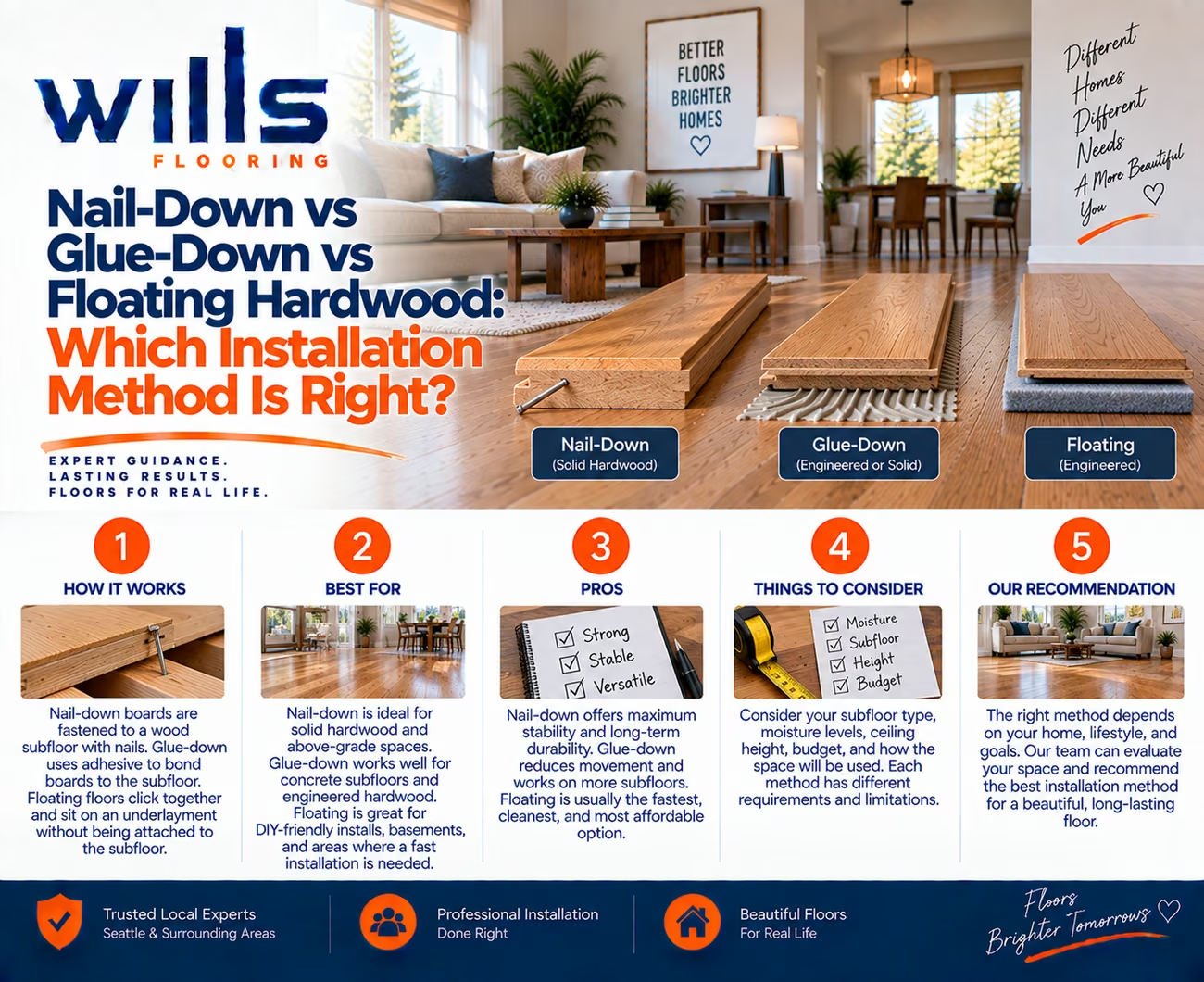
Nail-down is the right method for solid or engineered hardwood over a plywood subfloor, which covers the main and upper levels of nearly every Lynnwood rambler and split-level. Glue-down is the answer over a concrete slab or where you want the most solid feel. Floating is for click-lock engineered over slab, radiant heat or a sound underlayment. Wills Flooring's installation labor is $3.25 per sq ft for engineered or solid regardless of method. What changes between methods is the material line: nails, adhesive, moisture barrier or underlayment, quoted at the free estimate.
The method question usually comes up at our showroom on 196th St SW when someone from Alderwood or Martha Lake has read three forum threads and gotten three answers. The confusion is fair: online advice comes from every climate and every kind of house. In Lynnwood the answer is unusually clear, because most of our housing stock is 1960s to 1980s ramblers and split-levels with one plywood level and, in many split-levels, one slab level. Each level gets a different method, and here is why.
The three methods, explained
Most common in Lynnwood
Nail-down (and staple-down)
Boards are fastened through the tongue into a wooden subfloor with cleats or staples every 6 to 8 in. It is fast, quiet underfoot, and lets solid wood expand and contract naturally. It requires at least 3/4 in plywood or 23/32 in OSB with joists at 16 in. It cannot be used over concrete or over radiant tubing.
For slabs and the solidest feel
Glue-down
Boards are set into a trowelled bed of urethane adhesive over concrete or plywood. Done well it is the most solid, quiet floor of the three, with no hollow sound. It needs a flat, dry, tested slab, a moisture-blocking adhesive or separate barrier, and 24 hours before heavy traffic. Solid wood over 5 in wide is rarely glued; engineered is ideal.
Fast and forgiving
Floating
Engineered planks click or glue to each other at the edges and rest on a foam or cork underlayment, attached to nothing. It goes over slab, radiant heat, old vinyl and slightly imperfect subfloors, and it is the easiest to meet condo sound rules with. The trade-off is a slightly hollower feel and sound, and a need for expansion gaps and transitions in large rooms.
Side by side
| Factor | Nail-down | Glue-down | Floating |
|---|---|---|---|
| Works over plywood or OSB | Yes | Yes | Yes |
| Works over concrete slab | No | Yes | Yes |
| Solid hardwood | Yes, the standard method | Narrow boards only, with care | No |
| Engineered hardwood | Yes | Yes, ideal | Yes, click-lock or edge-glued |
| Feel and sound | Solid, quiet | Most solid, quietest | Slightly hollow without a quality pad |
| Radiant heat | Only with approved systems | Yes with compatible adhesive | Yes, most common choice |
| Repair a single board | Moderate | Difficult | Easy at edges, harder mid-room |
| Wills labor | $3.25 per sq ft | $3.25 per sq ft | $3.25 per sq ft |
Adhesive, moisture barrier and underlayment are material lines quoted separately. Stairs are $125 per stair with any method.
Price your Lynnwood hardwood install right now
Hardwood Installation Calculator
Installation pricing from our published rate card. Material is quoted separately based on the floor you choose.
Which method in which Lynnwood house
- 1960s Alderwood rambler · crawlspace, 1,050 sq ftPlywood subfloor over joists, oak already under the carpet in the living room. New solid or engineered oak nailed down to match. We check the crawlspace vapor barrier first, because a damp crawl cups nail-down floors.1,050 × $3.25 = $3,413 labor
- 1970s Martha Lake split-level · upper 820 sq ft, lower 480 sq ftUpper level is plywood: nail-down engineered. Lower level is slab on grade: the same engineered plank glued down after a moisture test, so the two levels match in color and only the fastening changes.(820 + 480) × $3.25 = $4,225 labor, plus adhesive for the lower level
- New townhome near the light rail · 640 sq ft + 13 stairsOSB subfloor, HOA sound rule for the unit below. Floating click-lock engineered over an acoustic underlayment meets the rule; stairs are glued and nailed because floating treads are not safe.640 × $3.25 + 13 × $125 = $3,705 labor
- Meadowdale remodel with radiant heat · 900 sq ftHydronic tubing under the subfloor. Floating engineered over a thin underlayment, or glue-down with a radiant-rated adhesive. No nails go anywhere near the tubes.900 × $3.25 = $2,925 labor
Glue-down or floating over a slab?
Glue-down
Glue when
- You want the most solid, quiet floor with no hollow footfall
- The slab is flat within 3/16 in over 10 ft, or you are willing to level it
- Wide-plank engineered, where floating floors can flex at the joints
- The floor is permanent and you are not planning to change it in ten years
Floating
Float when
- A sound underlayment is required by the HOA
- The slab has minor unevenness you would rather not grind
- Radiant heat or old vinyl is under the new floor
- Budget is tight: no adhesive cost and a faster install
Never skip the moisture test on a Lynnwood slab: Lower levels of split-levels built in the 1960s and 1970s often have no vapor barrier under the concrete, and Snohomish County groundwater rises all winter. We test slab moisture before quoting a glue-down or floating install. If readings are high, the fix is a moisture-blocking adhesive or a proper vapor retarder under a floating floor, not hope.
Method mistakes we get called to fix
- Nailing into a subfloor that is too thin. Some 1960s houses have 1/2 in plywood or old plank subfloor. Cleats do not hold, boards squeak within a year. A layer of 3/8 in plywood first solves it.
- Gluing over a dusty or sealed slab. Adhesive bonds to whatever is on top: dust, old paint, curing compound. Grinding or scarifying the slab is not optional.
- Floating a big open room without expansion. A 30 ft run of floating engineered needs its gap at every wall and, past the manufacturer's limit, a transition. Trap it under cabinets or an island and it buckles.
- Floating the stairs. Stair treads are always fastened, both glued and nailed, whatever the field of the floor is. A loose tread is a fall waiting to happen.
- Not asking which method is in the quote. Our hardwood installation quotes name the method for each level and list adhesive or underlayment on its own line, so you know exactly what is going under your floor.
Installation method questions from Lynnwood homeowners
Asked at the 196th St showroom and at estimates across Alderwood, Meadowdale and Martha Lake.
Is glue-down or nail-down hardwood better?
Does the installation method change the price?
Can solid hardwood be floated?
Does a floating floor feel cheap or hollow?
Can I glue hardwood directly to a concrete slab in a Lynnwood basement?
Which method is best for radiant floor heat?
Get the right method for each level of your house
We test the slab, check the subfloor and name the method in a firm written quote. Free in-home estimate anywhere in Lynnwood, samples included.
Wills Flooring serves Lynnwood, Everett, Seattle, Sammamish, Edmonds, Kirkland, Snohomish and the rest of Snohomish and King County from our Lynnwood showroom. See our hardwood installation in Lynnwood, WA, hardwood installation service, published price list, hardwood over a concrete slab, underlayment under hardwood and hardwood over a crawlspace.